 grovercentervet
The Complete Veterinary Guide to Dog Ear Infection Treatment
There are few things more upsetting to a pet parent than to see a joyful dog turn into a grumpy dog with ear infection. You may find your furry friend shaking its head, rubbing its face on the carpet of the living room or whining when you scratch behind its ears, the favorite spot. If this is the case, your pet has a condition called “otitis externa,” which is the inflammation or infection of the outer ear canal.
One of the most frequent problems that dog owners have is their dog’s ears. But it’s not always easy to come up with a solution that’s effective and permanent, simply by heading to the pet store to grab an over-the-counter drop. To be able to have the right dog ear infection treatment requires an understanding of what causes ear infections, how veterinarians diagnose them under a microscope, and how to get rid of them without risking your dog’s hearing.
This article is designed to delve into all the information you’ll need to know about how to get your dog healthy and comfortable again when it comes to treating ear infections.
The Anatomy Behind the Issue: Why Canines are Prone
To understand how important professional dog ear infection treatment is, one must consider the peculiar ear shape of a dog. The ear canals of humans are straight and horizontal. When a human has water or debris in their ear, it will usually flow right out, relatively easily.
But, dogs are not so anatomically equipped in this area. The external ear canal of a dog is very deep with an S-shaped curve.
The outer ear canal extends vertically down from the outside world, with a right turn almost perpendicular, into an inner ear canal, as shown on the above normal view diagram. This horizontal pathway ends up in the thin wall of the ear drum (tympanum).
This unique configuration not only allows dogs to have their great tracking sense of hearing, but is also extremely effective (and one way) as a trap. If moisture from a bath, thick wax or outside substances falls into the vertical canal, they are then pushed down by the force of gravity into the horizontal section. The sharp bend is not conducive to the circulation of air, which results in a dark hot and very humid pocket—the best breeding ground for micro-organisms. If left untreated, they multiply quickly and can cause a lot of pain.
Signs Your Pet Needs Treatment
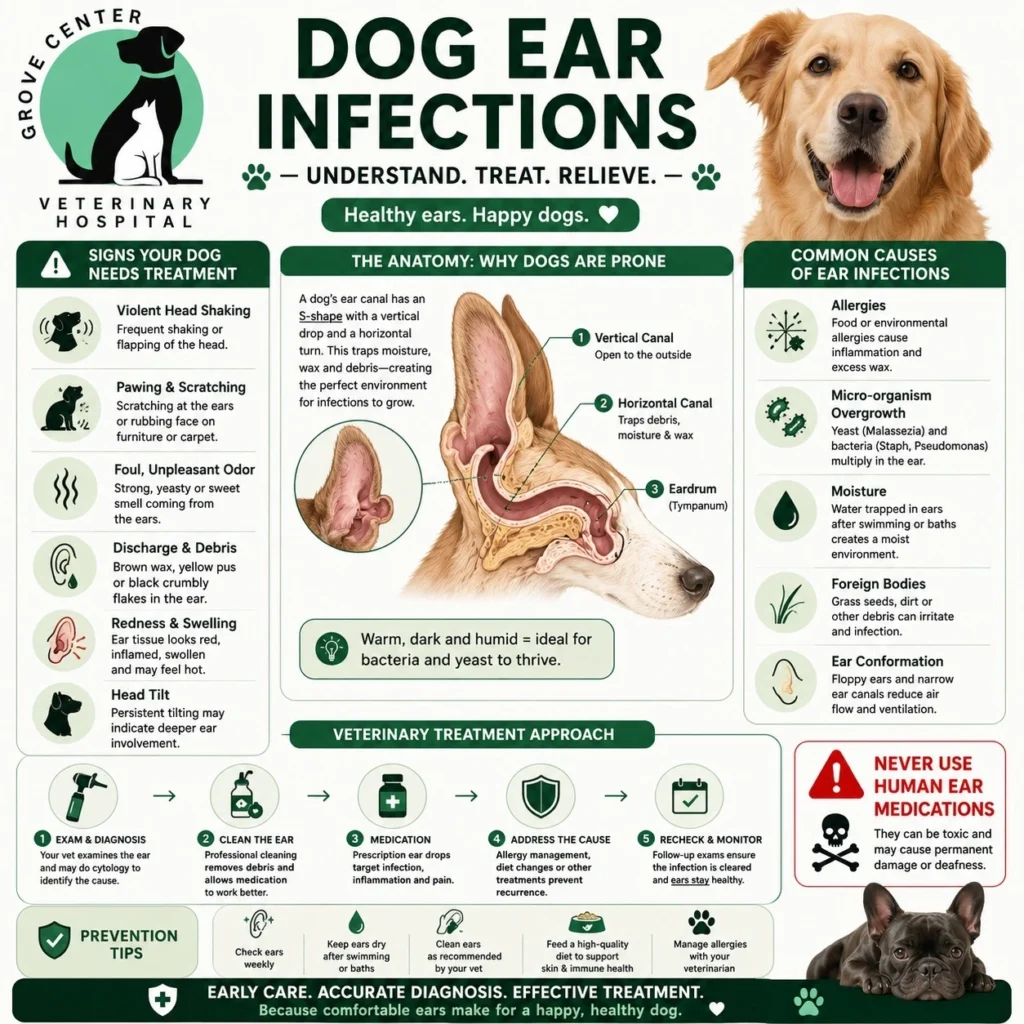
Many dogs will show signs by exhibiting physical changes and behaviors that indicate they need treatment for a dog ear infection. Does your pet exhibit any of these classic warning signs?
- Violent Shaking of the head: Violent Shaking of the head or frequent head shaking is an initial warning sign indicating that your dog is actively struggling to get over an ear infection, and needs to get professional dog ear infection treatment. Your dog will flap or shake head back and forth repeatedly as if trying to dislodge something from the canal.
- Pawing and Intensely Scratching: Scratching vigorously at the base of the ear with the hind legs or rubbing the face on the furniture. This can be a very aggressive scratching that can cause hair loss, bleeding and scabs in no time at all.
- Foul Unpleasant Odor: The healthy ear of a dog doesn’t smell. If you notice that when you sit near your dog you smell a strong pungent, yeasty or sweet odor, a microbial population has taken over.
- Color and Discharge: Healthy ears have a light pink color and are free of discharge. Check for hardened brown waxy substance, yellowish pus or black crumbly flakes in the crease of the ear flap.
- Redness and Swelling: The ear tissue will be bright red, raw, angry and obviously swollen and hot to touch.
- Persistent Head Tilt: Head tilted sideways, painful ear facing towards the ground. This behavior may indicate that the irritation has reached the middle and/or inner ear structures.
What's Going On? Common Triggers
There is no single “one size fits all” treatment for ear infections in dogs. This is because an ear infection is almost invariably a secondary symptom of some other underlying health issue that has damaged the defence barrier of the ear.
The most common ones can be grouped into the following categories:
Environmental and Food Allergies
Allergies are the number-one cause of chronic, recurring ear problems in dogs. It is important to note that the inflammation is in the skin of your dog, whether it is a food allergy (a chicken protein allergy or beef protein allergy) or environmental allergies (atopy to pollens, dust mites, or molds). The entire L-shaped canal is lined with skin tissue, which causes it to flare up, and compromises the natural barrier the oils in the dog’s ear put up. The result is excessive wax production, and the need for a recurring dog ear infection treatment by the owner.
Micro-organism Overgrowth
The ears have tiny, harmless amounts of yeast and bacteria that are part of a healthy ear. But when the canal’s climate changes, due to moisture or allergies, these populations go out of control.
- Yeast Infections: Discharge is greasy, dark brown, and has a sweet corn chip smell from the fungus Malassezia pachydermatis.
- Bacterial Infections: Moist yellow-green pus is formed by species such as Staphylococcus or Pseudomonas, and can lead to painful ulceration of the tissue walls.
Moisture and Foreign Bodies
Swimmers are often dogs that trap water in their horizontal ears, resulting in a moist environment which will allow infection to occur. In the same way, if a foreign body such as a grass seed head (foxtail) becomes stuck deep within the canal, it can cause sudden, localized swelling and severe pain which must be promptly medically cleared.
The Veterinary Diagnostic Approach
Proper dog ear infection treatment requires a professional diagnostic work-up to be performed. Randomly putting something into the ear or using old leftover ear drops from last year without knowing what they are may cause severe medical problems.
A routine examination will involve:
Otoscopic Examination
The veterinarian will use a special light instrument called an otoscope to examine the vertical and horizontal passages of the ear canal. With this step they can check for structural changes, foreign bodies or unnoticed tumors. The vet should also make sure that the ear drum is completely intact, which is a critical element for the test. If the drum of the ear is already broken, the topical liquid drugs can easily flow into the delicate inner ear cavity and result in permanent deafness or injury to the nerves.
Microscopic Ear Cytology
A sample of the discharge will be gently removed with a long cotton tip applicator by veterinary staff and smeared on a glass slide (microscopic ear cytology). The slide is stained and then looked at under the microscope.
Effective Treatment Protocols
After the type of pathogen is determined (based on the microscope findings), your veterinarian will develop a targeted dog ear infection treatment plan. The three critical phases are:
Phase 1: Clinical Cleaning and Flushing
The prescription topical medications cannot get through the thick wax and crust which will line the canal if this is fully plugged. Your veterinarian will use a safe and special earwax dissolving solution (ceruminolytic solution) to wash earwax out. If your dog is extremely itchy, painful, or aggressive because of the discomfort, a short acting sedative can be given to let the dog have a proper, deep flush without causing the painful areas to become too tense and painful.
Phase 2: Targeted Medication Delivery
Treatment of ear infections in dogs in Phase 2 involves targeted medication delivery, which is the main treatment method. They are usually very potent combination drugs with an antifungal component to clear up yeast, an antibiotic to combat bacteria, and a mild corticosteroid to rapidly decrease burning, swelling and itchiness.
If your dog is squirmy, head-shy or aggressive, consult your veterinarian about long acting extended release gels. These new drugs can be administered at the vet’s office once and the tablet disintegrates over 10-30 days and completely removes the daily hassle of home administration.
Phase 3: Treatment of the Underlying Cause
If the microscopic cytology shows that ear mites are present, a skin parasiticidal spot-on treatment will be given. If underlying food allergies are suspected to be playing a role in your pet’s symptoms, your veterinarian can help you arrange for a strict hypoallergenic elimination diet trial for 8-12 weeks to help avoid future flare-ups.
Complications: The Danger of Aural Hematomas
If you wait too long before getting your dog the correct therapy for a dog ear infection, your dog may seek relief from the intense itching and pain by licking his ears, which can result in a secondary physical injury.
From the moment it starts, a dog shaking its head violently and constantly is putting a tremendous amount of mechanical stress on the ear flap (pinna). The ear flap is made of a thin layer of cartilage enclosed between thin layers of skin and is covered with small blood vessels. If these small blood vessels get ruptured in the ear flap from aggressive head shaking, blood can leak into the ear.
When the small blood vessels get ruptured inside the ear flap due to head shaking, the blood can ooze into the ear.
Intense Ear Pain ──> Violent Head Shaking ──> Broken Blood Vessels ──> Aural Hematoma
These vessels once ruptured, fill rapidly with blood between the skin and cartilage, which results in heavy formation of a fluid-filled ‘pouch’ on the ear flap like a balloon or a pillow. This is a painful condition known as ‘aural hematoma’.
The fluid in an aural hematoma must be drained and the earflap stitched with special sutures, often a costly procedure, in order to prevent the ear from scarring closed and the ear flap from becoming permanently crinkled and distorted into a “cauliflower ear” shape. The best way to prevent this painful problem is to treat the internal ear problem early.
Conclusion
The key to a successful treatment of an ear infection in dogs is to get past the home remedies and get an accurate diagnosis from a veterinarian. The L-shaped design of the canine ear canal can easily turn a nuisance such as swimming water, too much earwax and allergens into a painful, long-lasting emergency. You can safely get rid of the infection by keeping an eye out for symptoms, such as head shaking, working with your veterinarian to get complete microscopic cytology, and completing all of the prescribed treatment. This helps to maintain your companion’s hearing and helps put him back on his feet.
Frequently Asked Questions
Are ear drops for dogs with ear infections not made from human ear drops or rubbing alcohol?
Absolutely, don’t put ear drops, rubbing alcohol or hydrogen peroxide in your dog’s ears. The inside of a dog’s ear is very sensitive and can be easily irritated. Harsh liquids will burn, cause raw ulcerations and cause extreme tissue swelling. Also, if your dog’s ear drum is hidden and has already ruptured, these liquids can enter the inner ear causing permanent neurological balance damage and irreversible deafness.
What is the usual time period for a dog ear infection to clear up?
By far the easiest, least complicated ear infections resolve in about 7-14 days with a prescription topical antibiotic. Acute or superficial bacterial infections, however, can be treated much more quickly, and may be cured entirely within a few weeks or months. After only a few days, your dog may seem to be doing fine; however, it is crucial to follow your veterinarian’s directions and finish the entire antibiotic treatment. Ceasing early gives the best bacteria the time and chance to remain alive for a subsequent antibiotic-resistant infection.
Why do my dog have recurring ear infections?
If your dog has to be given a dog ear infection treatment several times during the year then the ear infection is only a secondary symptom of the primary problem. Most common causes of chronic recurring ear inflamations are food and/or environmental allergies that lead to chronic skin inflammation. Other possible causes are deep-seated polyps, constricted ear canals and an undetectable rupture in the ear drum.
Can a dog ear infection be spread to other dogs or people?
The spread of an infection is entirely dependent on the cause of the infection. When the itching is due to an ordinary infection from bacteria or yeast, it’s 100% harmless to humans and other family pets. If ear mites are the cause, however, the mites are very contagious and will be passed between dogs and cats within the same household. Luckily, dog ear mites are unable to survive or reproduce on humans.
Can a dog get better from ear infection?
No, a dog ear infection will rarely go away on its own without a proper dog ear infection treatment. The ear canal has an L-shaped cavity and is very deep, making it hard for the body’s immune system to flush the trapped organisms away from the dark, moist environment in which yeast/bacteria populations can multiply. If left untreated, the infection will continue to spread through the head and will result in a ruptured ear drum, permanent hearing loss and extensive damage to the inner ear nerves.