
 grovercentervet
Pet First Aid for Bleeding: The Essential Guide for Pet Parents
When a pets parent realizes that their animal friend is hurt it can be one of the most terrifying moments to deal with. From a broken nail in a backyard chase to a puncture wound from an unexpected encounter with a wild animal to a deep wound from stepping on broken glass, it’s essential to respond quickly, steadily, and intelligently to the loss of blood.
Pet first aid for bleeding, before you can get to a professional veterinary clinic, can literally save your pet’s life. Although it might seem a small amount or a manageable amount to us, it can be a life-threatening emergency for a small dog or cat.
This overview covers the key principles of pet first aid for bleeding, how to stay calm, how to protect yourself, how to control the bleeding, and how to safely get your animal to the closest emergency vet.
1. Safety pet First aid : Protect Yourself and Your Pet
aThe absolute first priority in an emergency situation is to secure the area and protect yourself and your pet from defensive injury.
Lorem ipsum dolor sit amet, consectetur adipiscing elit. Ut elit tellus, luctus nec ullamcorper mattis, pulvinar dapibus leo.
Recognize the Pain Response
When an animal is very physically hurt or is very afraid, its primitive survival instincts completely overtake. The most well-mannered sweet and gentle dog or cat can bite, scratch, lash out or snap at their owner. It’s not malicious or aggressive, it’s a reaction that your subconscious brain is having in response to some pain.
Restrain the Animal Safely
Before going to the wound or giving any kind of pet first aid for bleeding, you need to safely restrain your pet.
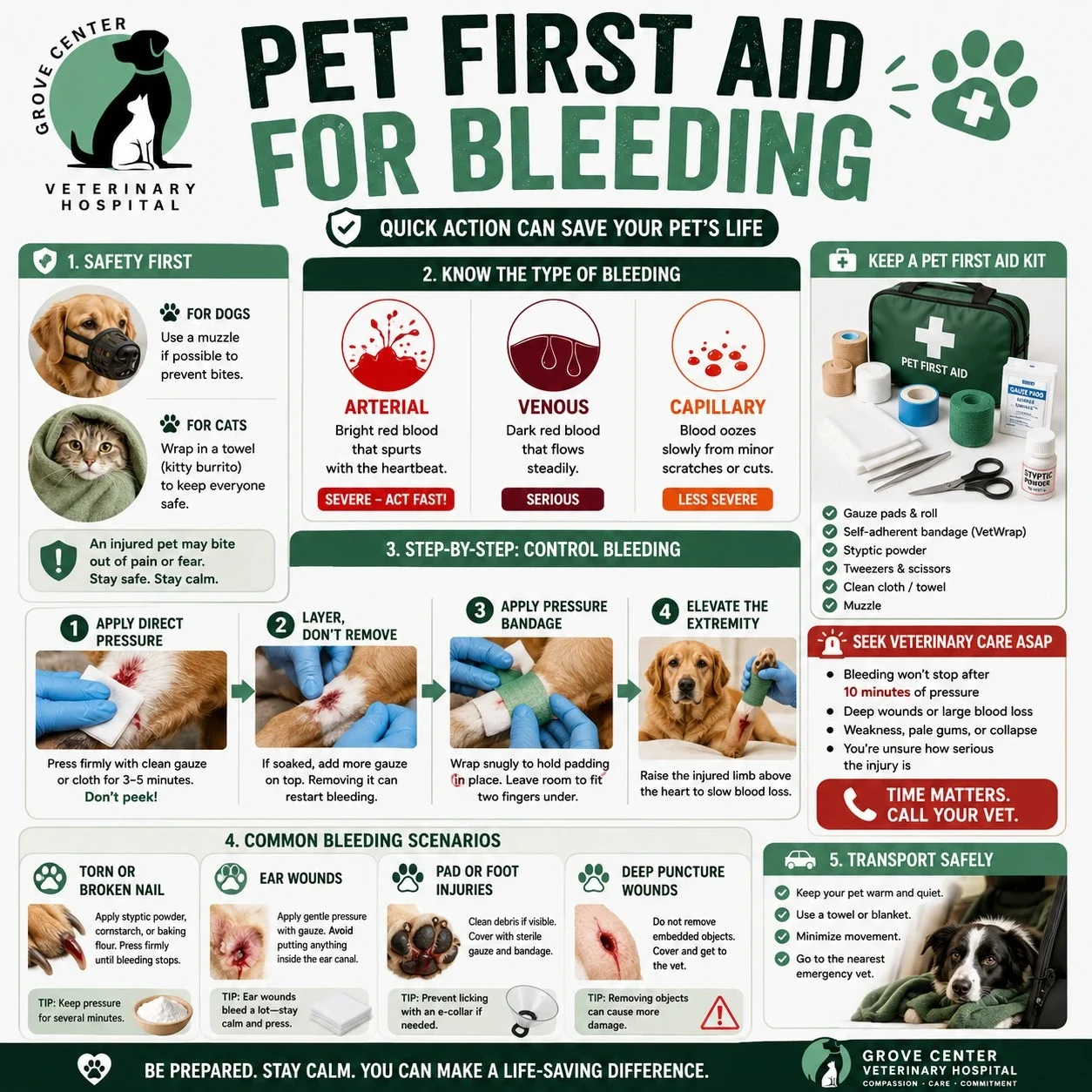
For Dogs:
If dogs do not have any of the following symptoms, they should be muzzled with a soft muzzle, or make one using a strip of soft gauze or a fabric leash that is wrapped snugly around the dog’s snout: vomiting, difficulty breathing, or a facial injury
For Cats:
In cats, gently but securely wrap the cat in a thick towel/blanket, leaving the injured area uncovered, often referred to as the “kitty burrito.” This helps to contain their legs and claws, and helps keep you and the feline safe as you try to stop the bleeding.
2. Identifying the Type of Wound
Not all wounds have the same “type”. As you apply pet first aid for bleeding, you’ll want to get it right, and the more you know about the source and severity of the fluid loss, the more context you can provide to your veterinarian when you call to get on the way to the clinic.
Arterial Bleeding
The most serious and harmful form of blood loss is called arterial bleeding. Arteries deliver blood right from the heart, and it is very oxygenated and under high pressure. If the artery has been cut, the blood will be bright red, and it will be seen to spurt or pulse with the animal’s heartbeat. This needs urgent and intense action.
Venous Bleeding
Venous blood is flowing back to the heart, and is not as pressurized. It will be darker red (almost maroon) and pour out steadily, continuously and heavily. Though less violent than an arterial injury, a venous laceration can still result in excessive and life-threatening blood loss if not contained.
Capillary Bleeding
This is common with minor abrasions, scratches and shallow cuts. The blood will slowly ooze from the skin surface. In general, capital issues will clot on their own within minutes, and can be easily cared for with simple home remedies.
3. Step-by-Step Procedure to Control Bleeding
If a wound is actively bleeding, there is a step-by-Step procedure for controlling the bleeding. This sequence ensures that you are able to treat a pet for bleeding without making it worse through pet first aid.
1.Apply Direct Pressure:Immediate Action.
Cover the wound with a clean sterile gauze pad, clean washcloth or sanitary sanitary pad. Using a flat hand apply pressure. Avoid pressing firmly to break underlying bone, as this will cause additional pain and bleeding; press firmly and steadily to promote clotting. Maintain this pressure for 3-5 minutes (no looking at the time).
2.Layer, Do Not Remove:Protect the Clot.
When the first layer of gauze is saturated, it should NOT be removed from the skin. Removing the wet gauze will cause the delicate, newly-formed blood clots to tear, thus re-initiating the bleeding. Rather, add more fresh clean gauze over the soaked and continue to apply firm pressure.
3.Use a Temporary Pressure Bandage:Securing the Area.
After a little slower flow, wrap a roll of stretch gauze or a self adhering bandage (such as VetWrap) snugly around the padding to secure it. Be sure there is enough room between the bandage and the skin for 2 fingers; if the bandage is too tight it will totally restrict blood flow resulting in serious skin damage.
4.Raise the Extremity:If Applicable.
If the injury is on a limb, paw or tail, gently lift the injured area so that it is above the animal’s heart level. A simple physics trick using gravity to lower the local blood pressure at the wound site, thus slowing the rate of fluid loss.
4. Handling Unique Body Situations
Each part of an animal’s body poses a special challenge. When it comes to dealing with bleeding injuries, treating your pet’s first aid according to the site of the injury will yield a lot more success. There are unique situations in a variety of parts of an animal’s body. When dealing with bleeding, knowing the exact location of the injury in your pet’s anatomy will lead to much better results in your pet first aid.
Torn or Broken Nails
Nails have a blood vessel and cluster of nerves in the middle area called the “quick.” A nail ripping will usually bleed a lot and look very scary, but it is not usually life threatening. Treat: Pack the nail with styptic powder, cornstarch, or baking flour, and press for a few minutes until it stops dripping.
Ear Injuries
Ear tissue is thin and packed with blood vessels. Sadly, if a dog or cat gets hurt in their ear, they will shake it vigorously! Its head shaking is similar to a centrifuge, splashing droplets across the room and continually re-opening the wound.
- Press straight on with the aid of the gauze.
- Whenever the ear is stopped, fold it gently over the top of pet’s head.
- Wrap a long band aid around their head and under their chin to keep their ear flat against their head and so it doesn’t flop back open again.
Internal Bleeding
The killer is invisible: Internal Bleeding. Your pet can internal bleed without any blood visible on her coat, if it was hit by a vehicle, fell from a height or was compressed during a fight. There is no normal pet first-aid for bleeding of the internal organs, so all you can do is to be able to recognize the signs of shock.
Quick Reference Summary Matrix
This is a reference table for assessing the type of injury and selecting the proper immediate action plan.
Injury Profile
Visual Characteristics
Severity Classification
Immediate First Aid Action
Arterial Wound
Bright red fluid, pulsing or spurting out
Critical Emergency
Heavy direct pressure, instant transport to vet
Venous Wound
Dark maroon fluid, steady pouring flow
Severe Emergency
Continuous direct pressure, apply pressure bandage
Capillary Wound
Slow oozing from surface skin layer
Minor / Manageable
Clean gently, apply light pressure, monitor
Internal Damage
No bleeding to be seen but you see internal bleeding, such as pale gums and weakness.
Critical Emergency
Keep pet warm and minimize movement, rush to vet clinic
5. Recognizing and Treating Shock
When a significant amount of fluids has been lost, an animal’s blood pressure falls too low, and the body enters a “shock” state. Advanced knowledge of shock; however, essential for pet first aid – bleeding.
- Pale or White Gums: Press your finger against above your pet’s teeth. In healthy gums, the pinkness will return in 2 seconds after pressure is released. If they will stay white, grey or light pink, your pet is in shock.
- Hypothermia: Their paws, ears and tail will be very cold.
- Rapid, Weak Pulse: Their heart rate will be very fast but the pulse in their inner thigh will be weak and difficult to find.
- Lethargy: The pet will be glassy-eyed, unresponsive, weak or completely unconscious.
If your pet shows you these symptoms, apply manual pressure bandage to stop the fluid from leaving its body right away. Tie your pet securely in a warm blanket to conserve his dropping core temperature, prop up his rear a little with a small pillow to circulate blood to his brain and rush to the closest emergency room.
6. Crucial Mistakes to Avoid
When the adrenaline kicks in during a crisis it’s very easy to make well-intentioned mistakes that can actually work against your companion’s wellbeing. Avoid these common errors when performing pet first aid for bleeding:
- Do Not Use Tourniquets: Unless a limb is completely severed, never apply a tight tourniquet. When 100% is cut off in a limb, irreversible tissue death and muscle necrosis will occur within a very short period of time, and often veterinarians will have to amputate a limb that could have been saved.
- Do Not Use Human Medicines or Ointments: You should never pour in hydrogen peroxide, alcohol or human antiseptic liquids directly into deep open wounds. The harsh chemicals break down normal cell structure and slow the body’s ability to heal. Rinse with clean water or sterile saline only.
- Do Not Postpone Veterinary Care: If you’ve been able to stop the surface flow of fluid with your pet first aid for bleeding, the crisis is not over. Large wounds must be closed surgically, deep punctures must be flushed internally with antibiotics to ensure that only a mild infection develops and the damage must be diagnosed to ensure that no damage has occurred inside the ball.
Conclusion
Accidents occur in a split-second time, but if you’re willing to respond to help a bleeding pet, you could become a lifesaver. You can successfully stabilize your dog or cat during the first few critical minutes if you remember to put it first: your pet’s safety comes first – secure them properly, apply steady and unyielding direct pressure without looking into the wound, cover the wound with fresh gauze over the old, and monitor for systemic signs of shock.
Make sure to have a well-equipped first aid kit in the home and in your car, have the phone number for your local veterinarian saved in your contacts and treat any time of significant blood loss with a leap straight to professional veterinary care.
Frequently Asked Questions
Q1: What is the first thing to do if my pet is bleeding profusely?
A: Your first line of defense is to safeguard yourself by properly restraining or muzzling your pet; even the gentlest animal can bite if it’s in pain. After it is safe, apply direct pressure, using clean gauze or cloth, to the wound while applying firm, continuous pressure.
Q2: May I use super glue on a dog wound which is still bleeding?
A: No, household super glue should not be used on an open wound. The superglues sold commercially can cause irritation to animal tissue, adhere the dangerous bacteria within the wound and cause damage to the tissue locally. Have a vet seal the wound properly using sterile, medical-grade adhesives or sutures.
Q3: When will I know when to measure direct pressure for a pet's wound?
A: Keep the pressure steady for 3-5 minutes and do not remove the gauze to view. If the blood clots are allowed to form “too early” the whole process of blood clots is interrupted again.
Q4: What home items can stop a torn nail from bleeding if I don't have styptic powder?
A: If you don’t have commercial styptic powder in your home kit, you can use cornstarch, baking flour, or even pack a clean bar of natural soap against the tip of the bleeding nail. Press firmly for several minutes to allow the powder to bind with the blood and seal the vessel.
Q5: How can I tell if my pet is experiencing internal bleeding after an accident?
A: Look closely for pale or white gums, rapid but shallow breathing, cold paws or ears, extreme lethargy, or weakness. If your pet has been in an accident and displays any of these symptoms, they may be losing blood internally and need to be rushed to an emergency vet clinic immediately.
This blog post is very important for pet first aid.
