 grovercentervet
Ovarian Remnant Syndrome in Dogs and Cats
When you bring your dog or cat home after the spay, you’re typically relieved. You are hoping that the days of heat cycles, behavioral changes, yowling and vocalizing are behind you. For some pet-owners, however, a strange situation arises weeks, months or even years into the future, when their dog or cat, who was completely spayed, suddenly starts to behave like a dog or cat in heat all over again.
If so, you may be experiencing some of these unusual behaviors in an unanticipated dog or cat and you may have something called ovarian remnant syndrome.
This complete guide explains everything that you would want to know about this condition, including why it occurs and how veterinarians can diagnose and treat it completely.
Add Your Heading Text Here
A spay (medically referred to as ovariohysterectomy or ovariectomy) is a procedure in which the entire animal’s uterus and both of its ovaries are completely removed. Since the production of hormone in the body is primarily from the ovaries, their removal removes the hormonal changes that cause heat cycles.
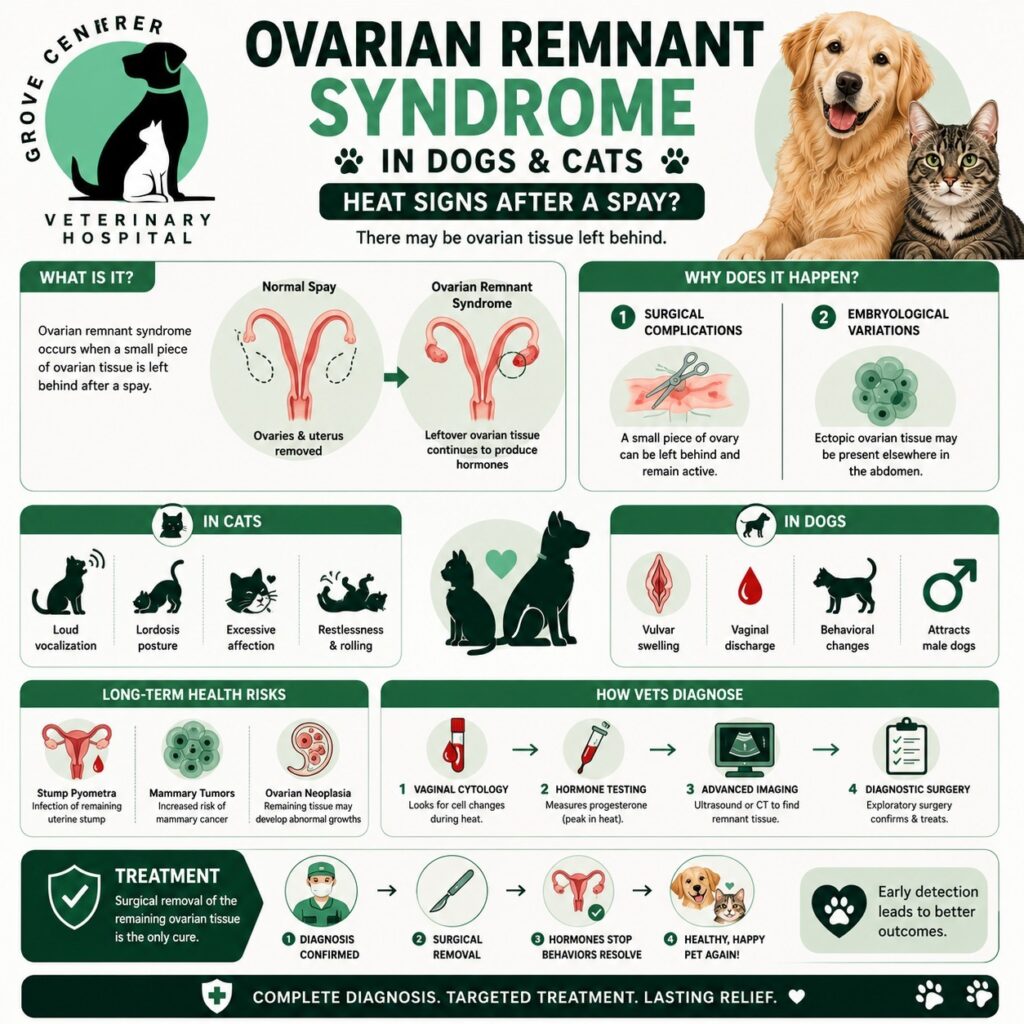
Ovarian remnant syndrome in dogs and cats is the condition that develops when the functional tissue of the ovary is removed during an ovariohysterectomy and is left inside the abdomen. This small piece of tissue is alive and continues to mature, to receive signals from the brain, and to produce hormones. This results in cyclical changes in behavior and physical characteristics of estrus (heat) even after the animal has been spayed.
The answer is as follows:
This is because:
If you’ve found out your cat or dog has ovarian remnant syndrome, it can be very frustrating. When the surgery has already been done, it’s understandable to ask how this came about. There are essentially two reasons why this syndrome may develop:
1. Surgical Complications
The most frequent occurrence is surgery leaving a small piece of the ovary in place. The ovary is held in place in the abdomen by a mass of connective tissue and blood vessels. It can be very difficult to see and completely remove tissue in deep-chested dogs, overweight pets or animals during active heat. Even a tiny fragment of the ovarian cortex can reconnect with a blood supply, and develop into a viable, hormone-producing fragment.
2. Embryological Variations
In less common cases, a pet may have “ectopic” (embryological) ovarian tissue. This resulted in a normal formation of small groups of ovarian cells in the fetal ovary outside the ovary proper. They are small pieces that are not seen with a normal spay surgery, but can develop later in life when the fragments enlarge and become active, thus causing ovarian remnant syndrome in dogs and cats.
Symptoms and Clinical Signs
The hallmark of the ovarian remnant syndrome in dogs and cats is the resumption of estrous signs and behaviors. The onset of symptoms can range dramatically—from months following the surgery to several years.
The symptoms appear slightly different when you have a dog vs. a cat.
Signs in Cats
- Persistent, Loud Vocalization: Feline estrus is very vocal. Your cat could begin yowling or “crying” a lot, particularly at night time.
- Lordosis Posture: The cat will usually rest the front legs on the ground, raise front legs and tail to one side.
- Overwhelming Affection: Rubbing against the legs, furniture or other items in the house excessively.
- Restlessness and Estrus Rolling: rolling around on the floor in a restive manner.
Signs in Dogs
- Vulvar Swelling in Dogs: The vulva will become swollen and be enlarged.
- Vaginal Discharge: discharge looks like a normal heat cycle and is bloody or straw colored.
- Behavioral Shifts: Moodiness, turning tail or standing to be mounted by male dogs.
- Male Attraction: Neighbourhood Male Dogs will be extremely attracted to her pheromones.
Long-Term Health Risks
Although it can be a big behavior problem, long-term management of an ovarian remnant syndrome in dogs and cats can have serious health implications.
Unchecked hormones over a long period of time greatly increase your pet’s risk for developing serious health issues as they get older.
The main long-term medical complications are:
- Stump Pyometra: If a fragment of the uterine horn (the “stump”) was left after the spay procedure, the ovarian remnant secretes progesterone which can lead to the stump thickening, accumulating pus, and becoming life-threateningly infected.
- Mammary Tumors: Abnormally high levels of estrogen can greatly raise the chance of a malignant mammary cancer occurring in both dogs and cats.
- Ovarian Neoplasia: The remaining tissue can develop an abnormal cell change which can result in ovarian tumors or cysts.
How Veterinarians Diagnose the Condition
Diagnosing the condition is sometimes not easy for veterinarians. Tissue which is microscopic or buried in the fat of the abdomen, gastrointestinal tract or other areas is usually not detected at first by standard x-rays or ultrasounds. Rather, a combination of strategic timing and lab testing is used.
Dogs and cats with ovarian remnant syndrome can sometimes be difficult to diagnose. This tissue is usually small or located deep within the fat in the abdomen, making it difficult to detect on a routine x-ray or ultrasound scan at first. Rather, it is a combination of strategy and lab tests.
What to Expect During and After Surgery:
An exploratory procedure and the previous incision line in the abdomen will have to be reopened. The surgeon will proceed step-by-step to examine the ovarian stumps around the kidneys. A pathologist confirms the presence of ovarian tissue after the tissue is found.
If it is found, the remaining tissue is carefully removed and submitted to a pathologist for confirmation that it is ovarian tissue.
Post-operative care is similar to that of a routine spay: a strict crate rest is recommended, activity is kept to a minimum for 10-14 days, a pain management medication is prescribed and an Elizabethan collar (e-cone) is placed on the abdomen to prevent her from licking at the incision site.
Conclusion
If you notice your dog or cat is having signs of ovarian remnant syndrome, it may make you feel uneasy, but it’s a very controllable condition and can have a very good prognosis. The most important initial step is to identify the physical and behavioral changes one will see when a spayed pet enters estrus. In conjunction with your veterinarian and with your dog in the midst of a hormonal cycle, you can have a successful chance at removing the remaining tissue with exploratory surgery and an accurate manner of hormone testing. This will overcome the unwanted behaviors and protect your pet from the potential for hazardous reproductive issues.
Frequently Asked Questions
Does a dog or cat have the ability to become pregnant with ovarian remnant syndrome?
No, if the uterus is removed entirely during the original spay, the pet with ovarian remnant syndrome will not be capable of becoming pregnant in dogs and cats. If she had only part of her uterus retained, however, she can actually have an ectopic or stump pregnancy, but this is very rare. She will still exhibit all the behaviors of a fertile animal, however.
How many days after spay does ovarian remnant syndrome occur?
There is no set period. Symptoms may be seen within a few weeks or months after the first procedure or may not be manifested for years. This depends on the amount of tissue left and how long it takes for the tissue to become sufficiently large to create a significant amount of hormone.